What does a D2C agency actually do?
A direct-to-consumer brand owns the whole customer relationship, from the first ad to the third reorder, so a D2C agency's job runs wider than media buying. A full-scope retainer covers six work areas that operate as one pipeline, not six separate services.
| Work area | What it includes | Measured by |
|---|---|---|
| Paid acquisition | Meta, Google, YouTube and, increasingly, Amazon and quick-commerce ads | Blended CAC, new-customer ROAS |
| Performance creative | Static, UGC and video variants produced weekly against a testing plan | Creative win rate, hook rate, cost per thumbstop |
| Store conversion | Product page structure, offer architecture, checkout friction, page speed | Conversion rate, AOV, cart abandonment |
| Organic and AEO | Category and product SEO, review and product schema, presence in AI answers | Non-brand organic revenue, share of AI answers |
| Influencer and UGC | Creator sourcing, briefs, whitelisting and rights for paid amplification | Cost per usable asset, CAC on whitelisted ads |
| Retention | Email, WhatsApp and SMS flows, subscription and win-back journeys | Repeat rate, revenue per customer, LTV to CAC |
If a proposal covers only the first row, you are buying a media buyer. That can be the right purchase, but price it as one.
How is a D2C agency different from a general marketing agency?
The difference is the number the agency is accountable for. A brand agency is judged on how the brand is perceived and produces campaigns, films and identity. A social agency is judged on content cadence and community. A D2C agency is judged on unit economics: what it costs to acquire a customer, what that customer is worth, and whether the gap is widening.
That changes the working rhythm. Brand work runs in campaigns; D2C growth runs in weekly cycles of creative production, testing and cutting. A brand agency might produce four assets a month; a D2C programme at scale needs twenty to forty variants, because creative fatigue, not audience targeting, is what caps performance on Meta today.
In D2C, the creative is the targeting. Anything that slows creative production slows growth.
Already running ads? Score the account first
Before you shortlist anyone, run a Google, Meta or LinkedIn Ads export through our free Ad Account Health Scorer for a 0–100 leak score and your top three leaks. It is a sharper brief than a wishlist, whether you run ads in-house or with an agency.
What services should a D2C agency provide?
The strongest D2C agencies treat the store, the media and the retention layer as one system, because a leak in any one wastes spend in the others. A complete scope spans four layers.
Foundation: store, tracking and data
E-commerce platform setup and optimisation on Shopify or WooCommerce, clean server-side tracking and events, product-page and checkout conversion work, and the analytics that let every rupee of spend be traced to contribution margin. Most underperformance a new agency inherits is a tracking problem before it is a media problem.
Demand: paid, organic and marketplaces
Paid acquisition across Meta, Google and YouTube; e-commerce SEO for category and product terms; answer-engine optimisation so the brand appears when buyers ask AI assistants for recommendations; and marketplace or quick-commerce presence where the category fits. A good agency tells you which channels to skip, not just which to run.
Creative: the engine of D2C
Performance creative, brand storytelling and content production, plus influencer and UGC sourcing with rights cleared for paid use. This is where most of the growth lever sits, and where thin agencies quietly cut corners. Our UGC and nano-influencer guide and influencer framework cover sourcing, briefing and measurement.
Retention: the margin layer
Email, WhatsApp and SMS lifecycle flows, subscription and replenishment journeys, and win-back sequences. Fulfilment and supply-chain logistics usually sit with the brand or a dedicated 3PL, but a good agency will flag when delivery times, returns or stockouts are the real cap on growth rather than marketing. Our D2C stack guide covers what to build, and in what order.
How do you choose the right D2C agency?
Fit beats fame. A creative-led agency and a performance shop answer genuinely different questions, and the right one depends on whether your brand's constraint is awareness, conversion or unit economics. A subscription-box business, a fashion label and a supplements brand each need a different centre of gravity. Six criteria separate a real partner from a plausible pitch.
Proof in your category
Named clients, live dashboards or ad-account screenshots, and the exact date range. Ask for two current clients at your revenue stage and ring them. A real case survives a reference call.
Creative capacity, stated as a number
Variants per month at your fee, who produces them, and the last three winning angles they found on a comparable brand. Vague answers here predict a plateau at month three.
Blended-CAC reporting
They should report blended CAC, contribution margin and new-customer share, and explain the gap between platform-reported and actual revenue without flinching.
Retention in scope
Whether they own email, WhatsApp and SMS flows or hand them back. Either answer is workable, but it must be explicit before signing.
Ownership and transparency
You keep the ad accounts, analytics, pixel, creative files and store code. Locked accounts and undisclosed subcontracting are the two red flags that most reliably predict a bad year.
Willingness to say no
A good partner will tell you when spend should be paused, when a SKU is not viable, and when the constraint is product or margin rather than marketing.
How much does a D2C agency cost in India?
Three tiers cover most of the market. What moves a brand up a tier is channel count and creative volume, not hours.
- Meta plus Google search
- 8–12 creative variants a month
- Tracking and events setup
- Store and checkout fixes
- Weekly reporting
- Full channel mix incl. marketplaces
- 20–40 creative variants a month
- Influencer and UGC pipeline
- CRO programme and A/B tests
- Email, WhatsApp and SMS retention
- E-commerce SEO and AEO
- Dedicated pod with named leads
- In-house-grade creative studio output
- Incrementality and MMM testing
- Quick-commerce and offline retail media
- Board-level reporting
Three billing models are in use. Flat retainer is the most predictable and easiest to audit. Percentage of spend, usually 8 to 15 percent of monthly media, aligns scale but rewards spending more. CPA or revenue share looks attractive and works only where conversion tracking is clean and fulfilment is reliable; where it is not, it produces disputes rather than growth. All figures exclude media, and GST applies to the management fee. The full model-by-model breakdown is in our performance pricing guide.
Are there affordable D2C agencies for startups?
Yes, provided you cut scope rather than quality. At Rs 40,000 to 80,000 a month a startup can run one or two channels well, produce eight to twelve creative variants, and keep tracking clean. What fails is spreading the same fee across five channels and a content calendar.
Below roughly Rs 35,000 a month, creative production is almost always the casualty, and creative is the primary lever in D2C performance. If that is the budget, the better sequence is a one-time setup engagement covering tracking, store conversion and a starter creative library, then a lighter monthly media scope once the fundamentals hold. Growth is easier to fund from margin than to buy on a thin retainer.
If you are a manufacturer moving into D2C
A large share of India's best new D2C brands are not first-time founders. They are established manufacturers, many led by owners in their fifties and beyond, who have run a profitable factory or wholesale business for two or three decades and are now selling to the consumer directly. If that is you, you start with advantages a 25-year-old founder would pay dearly for: you own the product, you control quality and cost, you understand margin in your bones, and you have supply that does not run out. The gap is not business sense. It is a new distribution language, spoken in CAC, ROAS and creative cycles rather than distributors, credit periods and order books.
The instinct built over decades of trade, protect margin, do not overspend, judge a deal on the bottom line, is exactly the right instinct for D2C, and it is why manufacturer-owners often make sharper clients than funded startups chasing growth at any cost. Where the model differs is that consumer acquisition is bought in small, testable increments and improves week by week, rather than negotiated once a season. A good agency's job is to translate: to report in the all-in ROAS and contribution-margin terms above, so the numbers map onto the P&L discipline you already trust, and to move at a pace that respects your capital rather than burning it to hit a vanity target.
Two cautions worth naming for an experienced operator. First, resist judging digital by the cost-per-unit logic of a factory; early spend buys learning and data, and the real return shows from month three, not week one. Second, keep ownership of the accounts, data and creative from day one, the same way you would never hand a supplier the keys to your plant. Handled well, the move from manufacturing to D2C turns a business that sold through others into one that owns its customer, its data and its margin, and that is a stronger, more valuable company. If you want a plan framed in the numbers you already run your business on, tell us about your product and margins.
Which customer acquisition strategies actually work?
- Creative volume over audience tinkering. With broad targeting doing the work on Meta, the testable variable is the asset. A steady weekly cadence of hooks, formats and angles beats any bid-strategy tweak.
- Offer architecture as a lever. Bundles, sample sizes and subscription entry points change CAC more than creative in many categories, because they change AOV and first-purchase friction.
- Search for demand you did not create. Google search and Amazon capture existing intent at lower CAC than social prospecting; most brands underweight it early.
- Whitelisted creator ads. Running paid spend through creator handles typically outperforms brand-handle equivalents on cost per acquisition in beauty, food and wellness.
- Quick commerce where the category fits. For food, beverages and personal care, Blinkit, Zepto and Instamart now work as both a sales channel and a discovery surface with their own ad inventory.
- AI answer visibility. Buyers increasingly ask assistants to recommend products. Product schema, review markup and comparison content decide whether your brand is in that answer. See what AEO is.
How much do SEO, GEO, AEO and new ad platforms add to D2C revenue?
Paid social builds demand, but it is rarely the whole revenue engine, and it is the most expensive part of it. The channels that quietly compound D2C revenue are the organic and answer-layer ones, because their cost per order falls over time while paid media's rises. In a healthy mid-stage D2C mix, no single channel should own the P&L.
| Channel | What it contributes | Typical share of revenue at scale |
|---|---|---|
| Paid social & search | Fast, scalable new-customer demand; the volume lever | 40–60% |
| SEO (organic) | Category and product traffic at falling cost per order; compounds | 10–25% |
| AEO / GEO (AI answers) | Being named when buyers ask ChatGPT, Gemini or AI Overviews for a recommendation | 3–10% and rising |
| Retention (email, WhatsApp, SMS) | Repeat revenue at near-zero marginal cost; protects margin | 20–35% |
| Influencer & creator collabs | Trusted reach, whitelisted ad creative and a UGC library that feeds paid | 10–20% |
| Marketplaces & quick commerce | Discovery plus fulfilment where the category fits | Category dependent |
SEO is the cheapest revenue a D2C brand owns once it ranks: category-education and product content that keeps converting after the spend stops. AEO and GEO are the fastest-growing surface, because a rising share of product research now begins inside AI assistants rather than a search box; product schema, review markup and comparison content decide whether your brand is in that answer. Our guides on what AEO is and GEO vs AEO vs SEO cover how to compete there.
On the paid side, the inventory is widening beyond Meta and Google. Programmatic and CTV extend prospecting into display, video and connected-TV placements at lower CPMs than social for upper-funnel reach, useful once creative and tracking are solid. AI-platform ads, including sponsored placements arriving inside ChatGPT and other assistants, are early but point the same way as quick commerce did three years ago: the surface where buyers research is becoming a place to advertise. A D2C agency's job is to test these as they mature without letting them distract from the channels already paying, and to measure each one on incremental orders, not clicks.
The compounding channels, SEO, AEO and retention, are what turn a brand that buys revenue into one that owns it.
Where influencer and creator collaborations fit
In D2C, influencer work is a production channel as much as a reach channel, and that is what makes it pay. A single creator collaboration does three jobs at once: it borrows the creator's trust with a warm audience, it produces rights-cleared UGC that becomes your best-performing paid creative when you whitelist it through the creator's handle, and it feeds the AEO and review layer with third-party mention. The benefit compounds because one shoot can supply a month of ad variants at a fraction of studio cost.
Nano and micro creators usually beat celebrity reach on cost per acquisition in beauty, food and wellness, because engagement and believability, not follower count, drive D2C conversion. The valuable output is the usable, media-ready asset, not a one-off post, so brief for it and secure usage rights up front. Our UGC and nano-influencer guide covers sourcing and costs, and the influencer framework covers briefing and measurement.
How do D2C agencies improve retention and engagement?
Acquisition costs rise every year; retention costs almost nothing to run once the flows exist. A working retention stack for an Indian D2C brand is four things: WhatsApp as the primary channel, because open rates dwarf email locally; email for margin-heavy lifecycle content; SMS reserved for transactional and time-bound offers; and a subscription or replenishment reminder for consumables.
Expect measurable revenue contribution within six to eight weeks of launching flows. A reasonable target is 20 to 30 percent of monthly revenue from returning customers by month six, higher for consumables. If an agency's proposal has no retention line, it is proposing to grow the most expensive part of your P&L only.
What metrics do D2C agencies track, and how do you evaluate performance?
Category matters more than city, so treat these as working ranges to argue with, not targets to copy.
Two rules matter more than the numbers themselves. First, judge blended CAC across all spend, not platform-reported ROAS, which double counts. Second, contribution margin after shipping, returns, discounts and payment fees is the only figure that tells you whether a scaling brand is actually earning. A brand at 4x platform ROAS and negative contribution margin is buying revenue, not growth. A monthly report should show spend pacing, CAC by channel and blended, creative learnings, retention, and next month's plan with the CAC assumption behind the forecast. Our ROI benchmarks guide sets out the full measurement structure.
Serious D2C founders no longer accept a 4x that only counts media spend. The number they hold an agency to is all-in ROAS: revenue divided by every cost of getting the sale, media plus the agency retainer, creative production, tools, transaction fees and GST. A campaign at 4x on media can collapse below 2x all-in once the retainer and production are added, which is why blended and platform ROAS flatter and MER after all costs tells the truth.
The cleanest way to think about it is a simple stack. Take a brand spending Rs 10 lakh on media at a reported 4x, so Rs 40 lakh in revenue. Add a Rs 1.5 lakh retainer, Rs 1 lakh of creative and tools, and roughly Rs 3–4 lakh of payment fees, shipping and returns, and the true return on total marketing cost is closer to 2.5–2.8x, not 4x. A D2C brand grows profitably only when that all-in figure stays healthy, which is exactly why the compounding channels above, SEO, AEO and retention, matter: they lift revenue without adding proportional cost, pulling all-in ROAS back up as paid media alone drags it down. Ask any agency to report ROAS both ways, on media and all-in, from month one.
D2C agency case studies with real results
The fastest way to judge a D2C agency is to look at brands it has already grown, and how it counts the result. These are live NPR Design engagements across the categories most D2C startups fall into, each with a full breakdown you can read.

Logo, packaging and the Shopify store, then ads and social. Over ₹3,00,000 in sales on ₹75,000 of media, and 326.6K Instagram views.
Read the case →D2C menswear brand scaling Meta Ads to 53.8 lakh annual impressions and 480 purchases a year at ₹441 cost per purchase.
Read the case →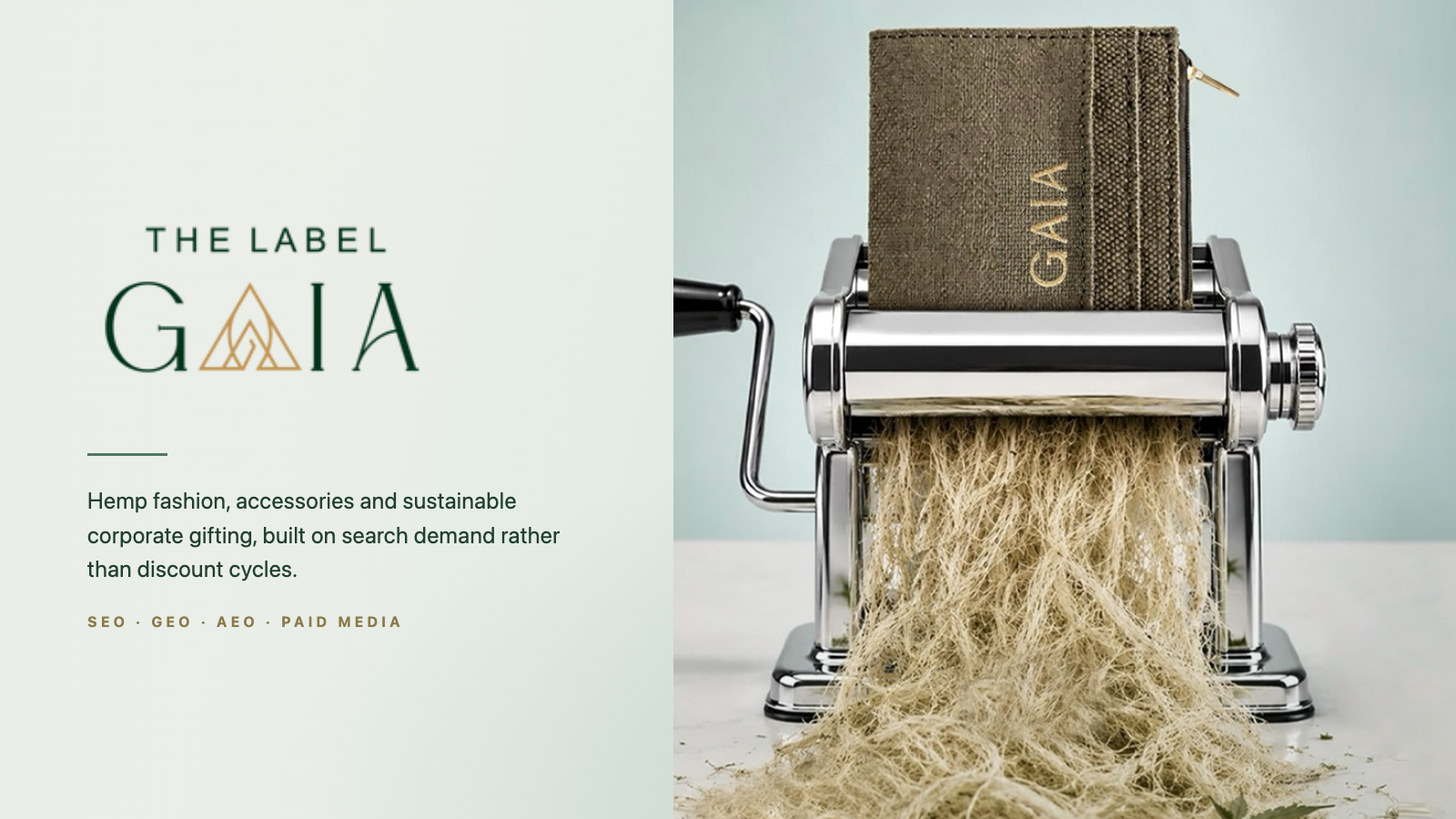
Hemp fashion and gifting. Category-education SEO plus retargeting-led paid drove 100+ sales a month over a six-month engagement.
Read the case →Alongside these, our summarised D2C engagements include Luminé Beauty, a Mumbai skincare brand scaled from ₹40K to ₹3L a month in Meta spend while holding ROAS above 4.8x across 14 SKUs; CrispBites, an Ahmedabad snacking brand that built a pan-India presence and ₹2Cr in Year 1 on Shopify, local SEO and social; and ModaHub, a Bengaluru fashion label that grew revenue 340 percent in a quarter with an Instagram-first content and influencer engine. The full set, filterable by D2C, sits on our case studies page.
Which D2C trends are shaping 2026?
- Quick commerce as a discovery channel. For food, beverage and personal care, Blinkit, Zepto and Instamart are now acquisition surfaces, not just fulfilment.
- AI answers as a shopfront. A growing share of product research starts in ChatGPT, Gemini and Google AI Overviews. Brands with clean product and review schema get named; the rest are invisible. Our GEO vs AEO vs SEO guide breaks down how to compete there.
- Creative velocity as the moat. With targeting commoditised, the brands that test the most angles win. AI-assisted production is closing the volume gap for smaller teams.
- Retention-led economics. As acquisition costs climb, LTV and repeat rate, not first-purchase ROAS, are becoming the numbers investors and founders track.
- Profit over vanity growth. Contribution margin has replaced top-line revenue as the growth metric that matters, especially for funded brands.
How do you brief, get a quote and onboard a D2C agency?
Brief on the commercial target, not the deliverables. Share your AOV, gross margin, current CAC, target units and stock position, and for a launch, the date. Ask in return for a 90-day plan that states creative volume, channel split, the CAC assumption behind the forecast, and what happens if week two comes in 40 percent above target CAC.
For onboarding, expect two to four weeks for tracking and account setup, six to eight weeks for the first reliable creative winners, and a stable CAC by month three. Keep ownership of your ad accounts, pixel, analytics and creative files from day one, and agree the monthly report format before the first invoice.
Get a D2C proposal built on your actual margins
NPR Design runs D2C growth programmes for brands across India and internationally, quoted in a transparent sub-total plus adjustment format. Send us your AOV, margin and current CAC and we will come back with a 90-day plan, the creative volume behind it, and a quote.
- Just starting? We will tell you what to build first and what to leave until later.
- Already scaling? We will score your current account and show you the leaks before you commit.
- Not a fit? If your constraint is product or margin rather than media, we will say so.
See our D2C growth service for how the work runs, and the case studies for what it produces.
Frequently asked questions
What does a D2C agency do?
A D2C agency runs the full path from first impression to repeat purchase for a direct-to-consumer brand: paid media on Meta, Google and quick-commerce platforms, performance creative production, conversion work on the store, e-commerce SEO and AEO, influencer and UGC sourcing, and retention through email, WhatsApp and SMS. Unlike a general marketing agency it is measured on blended CAC, contribution margin and repeat rate rather than reach.
How much does a D2C agency cost in India?
Launch scopes run about Rs 40,000 to 80,000 a month, growth retainers Rs 90,000 to 2,50,000, and funded or multi-market programmes Rs 2,50,000 to 6,00,000 and above. All figures exclude ad spend, and GST applies on the management fee. Percentage-of-spend models typically sit at 8 to 15 percent of monthly media. See the full pricing breakdown.
How do I choose the right D2C agency for my brand?
Judge on six things: proof in your category, creative capacity stated as a monthly number, blended-CAC and contribution-margin reporting, whether retention is in scope, account and data ownership, and willingness to say no. A creative-led agency and a performance shop answer different questions, so match the agency's centre of gravity to whether your constraint is awareness, conversion or unit economics. Ask for two current clients at your revenue stage and call them.
Are there affordable D2C agencies for startups?
Yes. A startup can run a credible programme at Rs 40,000 to 80,000 a month with scope narrowed to one or two channels, a fixed creative volume and clean tracking. Below roughly Rs 35,000 a month, creative production is usually the casualty, and creative is the main lever in D2C performance. A one-time setup engagement first, then a lighter monthly scope, often works better on a thin budget.
What is a good CAC and ROAS for a D2C brand in India?
As working ranges in 2026: blended ROAS of 2.5 to 4 for beauty and personal care, 3 to 5 for apparel at healthy AOV, and 4 or above for supplements and food. CAC should sit below one third of first-year customer value, repeat rate above 25 percent by month six, and contribution margin positive after shipping, returns and discounts.
What metrics do D2C agencies track?
Blended CAC across all spend, contribution margin after shipping, returns, discounts and fees, new-customer share of revenue, repeat purchase rate, LTV to CAC ratio, and creative win rate. Platform-reported ROAS alone is not enough because it double counts. A monthly report should show spend pacing, CAC by channel, creative learnings, retention and next month's plan.
Can I see case studies of D2C agency work?
Yes. Read Yo Indulge for a confections launch that turned ₹75,000 of media into over ₹3,00,000 in sales, Cambridge Garments for D2C menswear scaled to 3.85x ROAS, and The Label Gaia for a sustainable fashion brand grown through SEO and retargeting. The full, filterable set is on our case studies page.
How long before a D2C agency shows results?
Two to four weeks for account restructure and clean tracking, six to eight weeks for the first reliable creative winners, and about three months for a stable CAC. Retention flows on email and WhatsApp usually show measurable revenue contribution within six to eight weeks of launch.
Should a D2C brand hire an agency or build in-house?
Below roughly Rs 10 lakh a month in media spend, an agency is usually cheaper and faster than the three to four hires the same scope needs. Above that, a hybrid works best: in-house owns brand, creative direction and retention, while the agency runs media buying, creative volume and experimentation.
How do I request a quote or consultation from a D2C agency?
Share your AOV, gross margin, current CAC, target units and stock position, and ask for a 90-day plan with creative volume, channel split and the CAC assumption behind the forecast. To start with NPR Design, request a proposal with those numbers and we will return a plan and a transparent quote.